
Converting Units: mg, mcg, mL, Units — Conversion Practice
A practical guide to the unit conversions nursing students use constantly — milligrams, micrograms, milliliters, and units — with practice problems.
Before you can tackle IV rates, weight-based dosing, or anything else in dosage calculation, you need to be completely comfortable converting between units. This is the foundation everything else is built on — and it's also where a surprising number of errors happen, usually from a simple decimal or unit mix-up rather than not understanding the concept.
The conversions you'll use constantly
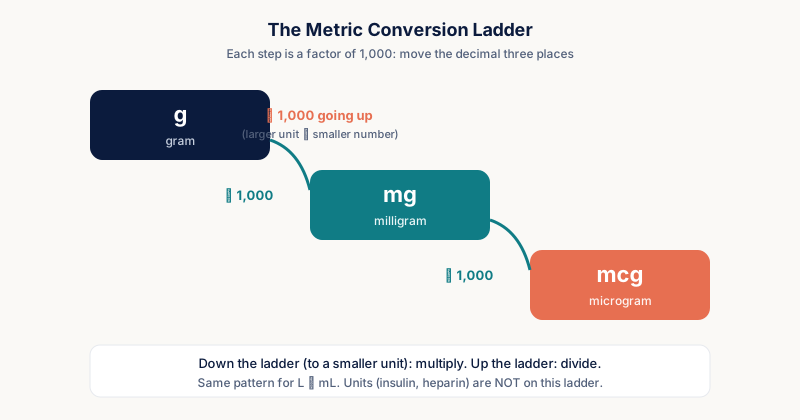
| Conversion | Relationship | |---|---| | Milligrams to micrograms | 1 mg = 1,000 mcg | | Grams to milligrams | 1 g = 1,000 mg | | Liters to milliliters | 1 L = 1,000 mL | | Kilograms to pounds | 1 kg = 2.2 lb |
Why micrograms and milligrams get confused so often
The abbreviations "mg" and "mcg" look similar enough — especially in handwriting or a rushed read — that mixing them up is one of the most well-known sources of medication error. This is why the symbol "μg" is on safety organizations' do-not-use lists: it is easily misread as "mg." Write "mcg" instead.
Worked example
A medication is ordered as 0.5 mg. The medication on hand is labeled in mcg. How many mcg is the ordered dose?
Step 1: You are moving from a larger unit (mg) to a smaller one (mcg), so multiply — 0.5 mg × 1,000 = 500 mcg
Quick self-check
Converting to a smaller unit should give you a bigger number. If 0.5 mg turned into 0.0005 mcg, you divided when you should have multiplied.
What about "units"?
Some medications — insulin is the most common example, heparin is another — are dosed in units, which is not a weight-based measurement like mg or mcg at all. Units measure biological activity specific to that medication, which is why insulin dosing uses its own dedicated syringe (marked in units) rather than being converted into mg or mL. Never attempt to convert units into a weight-based measurement — they're not interchangeable.
More on this in insulin dosage and sliding scale practice.
Common mistakes to avoid
- Mixing up mg and mcg, especially under time pressure
- Treating "units" as if it were convertible to mg or mL
- Losing track of a decimal point when multiplying or dividing by 1,000
- Writing a "naked" decimal (.5 mg) instead of using a leading zero (0.5 mg)
Practice problems
- Convert 250 mcg to mg.
- Convert 2.5 L to mL.
- Convert 1,500 mg to g.
Answers:
- 250 ÷ 1,000 = 0.25 mg (moving up to a larger unit, so divide)
- 2.5 × 1,000 = 2,500 mL (moving down to a smaller unit, so multiply)
- 1,500 ÷ 1,000 = 1.5 g
Once conversions are automatic, move on to oral medication calculations and weight-based dosing.
Solid unit conversion skills make every other dosage calculation easier. The Complete Dosage Calculation Practice Workbook builds from these foundational conversions all the way through IV rates, weight-based dosing, and high-alert medication math.