
Oral Medication Calculations: Tablets, Liquids, and Ratios
The two main methods for solving oral medication dosage problems — ratio-proportion and dimensional analysis — explained with worked examples.
Oral medication calculations are usually the first dosage math nursing students learn, and for good reason — they're foundational to the ratio-based thinking that carries through IV calculations, weight-based dosing, and everything else in this subject area.
Two methods, same answer
There are two common approaches to solving oral medication problems. Most programs teach one as primary, but knowing both gives you flexibility — if one method isn't clicking for a particular problem, the other might.
Method 1: Ratio-Proportion
Have (dose on hand)       Desired (dose ordered)
-------------------   =   ----------------------
Have quantity             x (quantity to give)
Keep the same unit on top on both sides (for example, mg) and the same unit on the bottom on both sides (tablets or mL). Cross-multiply and solve for x.
Method 2: Dimensional Analysis
Set up a chain of conversion factors so that unwanted units cancel out, leaving only the desired unit in the final answer. Start with what you are solving for (tablets or mL), then multiply by fractions arranged so each unit you don't want appears once on top and once on the bottom.
Worked example: tablets
Order: 500 mg. On hand: 250 mg tablets. How many tablets?
Ratio-proportion: 250 mg / 1 tablet = 500 mg / x tablets → 250x = 500 → x = 2 tablets
Dimensional analysis: 1 tablet / 250 mg × 500 mg = 2 tablets (mg cancels, tablets remain)
Worked example: liquid medication
Order: 375 mg. On hand: liquid medication labeled 125 mg/5 mL. How many mL?
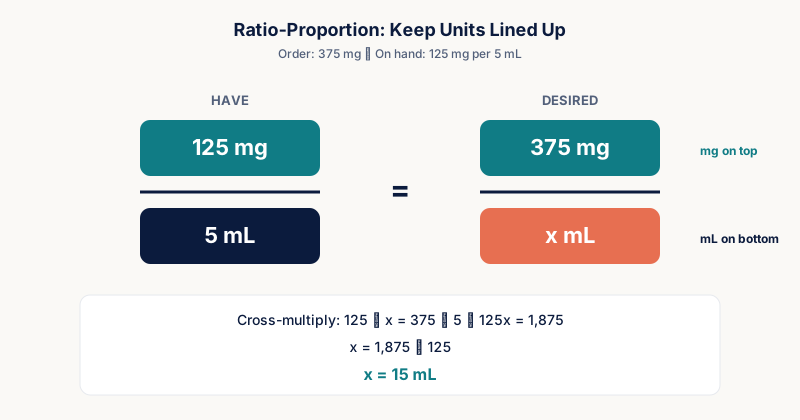
Ratio-proportion: 125 mg / 5 mL = 375 mg / x mL → 125x = 1,875 → x = 15 mL
Dimensional analysis: 5 mL / 125 mg × 375 mg = 1,875 / 125 = 15 mL
Both methods land on the same answer — that's your built-in cross-check.
Why this foundation matters
Once ratio-proportion thinking feels natural with tablets and liquids, the same logic extends directly into IV rate calculations and weight-based dosing — you're not learning a brand-new skill each time, just applying the same reasoning to a new scenario.
Convert first
If the order is in g and the label is in mg, convert before setting up the ratio. Review the unit conversion guide if that step feels shaky.
Common mistakes to avoid
- Setting up the ratio with units mismatched (mg on one side, mL on the other, without the proper unit pairing)
- Rounding a tablet count to a number that isn't actually practical to administer (e.g., 2.3 tablets) without double-checking the order or available tablet strength
- Skipping a sanity check — if the calculated answer seems wildly different from what the "have" dose suggests, recheck the setup
Oral medication math is one of several calculation categories covered in full, with worked solutions, in the Complete Dosage Calculation Practice Workbook.